The platform
The SCADA of the future
SCADA software has been around for decades. The acronym stands for ‘Supervisory Control And Data Acquisition‘ and covers control systems used to monitor and control plants, systems and infrastructure.
A few years ago, projects began to emerge that took a modular, open source approach. InterSCADA develops and tests specific modules or services for such a platform.
The InterSCADA platform is an open-source, vendor-independent control system. Newly implemented monitoring and control functions and automation mechanisms will enable distribution and transmission grid operators to respond quickly to sudden system disruptions.
The levels
The platform's architecture
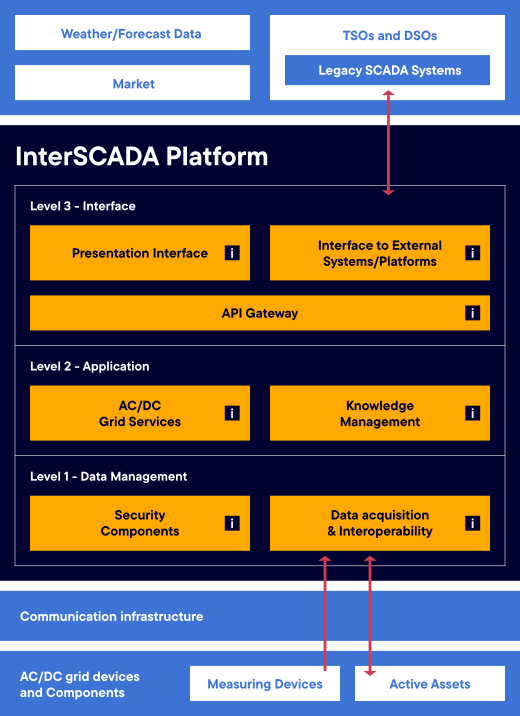
The InterSCADA platform builds on the forerunner SOGNO platform (Service Oriented Architecture for the Digitalisation and Automation of Distribution Grids) and it will span three levels:
The data management level constitutes the interface of the InterSCADA platform with the grid devices and components. This facilitates the interoperable interconnection with the external devices and systems installed in the electrical grid. Essentially functioning as dedicated software adapters, the data acquisition and interoperability components handle a variety of communication protocols and operate as translators (converting data from its original structure to the data model and format used within the platform, or vice versa). The pivotal component enabling (near) real-time communication through the publish/subscribe mechanism is the message broker. Functioning as a router, it receives messages from publishers and directs them to one or more subscribers. The routing process is guided by message topics, as data from publishers is consistently tagged with specific topics. Moreover, security is ensured across the entire platform and the communication channels, through efficient cybersecurity mechanisms to cover preventive and corrective security methods, including a virtual redundancy approach.
The application level refers to the software components, deployed as microservices, for analysing and controlling the system of mixed, hybrid AC/DC grids. In the InterSCADA system architecture, real-time applications exchange data flows through the message broker, which is part of the knowledge management component. This encompasses continuous operations supporting AC/DC grid management and event-based applications (e.g., optimal power flow and state estimation) that must promptly respond to specific triggers. Different services, such as WAMPAC, exemplify an event-based application that remains inactive for most of the time, but must react swiftly to power system issues, such as voltage instabilities, power oscillations, and excessive frequency variations. Consequently, these applications will be equipped with a publish/subscribe interface for communication with the message broker. Databases play a central role in the data management module, similar to the message broker, and they are implemented in a distributed manner for scalability. Thus, beyond offering storage functionalities, the data management service also includes tools for access control, data reception from the message broker, data aggregation/maintenance, and it ensures data persistence.
The interface level refers to the integration of the InterSCADA platform with the existing systems of DSOs and TSOs, as well as the interface with the users via dedicated graphical tools. It establishes connections with other pertinent IT systems, such as market platforms (e.g., for the execution of ancillary services), weather/forecast providers (e.g., to determine load and generation power injections) and existing SCADA and energy management systems of TSOs and DSOs. Analogous to the components in the data management level, the components indicated as interface to external systems/platforms serve a dual role: facilitating communication with partner systems and executing the necessary data translation to convert external data into the platform's internal data model/format. At the upper echelon of the architecture, the presentation interface supplies tools and graphical user interfaces (GUI) to present data to grid operators. GUI will furnish real-time updates on the network's states and deliver information concerning essential actions for grid control. This includes details on automated operations, whether completed or forthcoming, as well as manual operations that necessitate the operator's intervention. The GUIs access data through the API gateway, enabling easy customisation of visualised data by adjusting queries accordingly.
Pilot demonstrators
Validating the platform
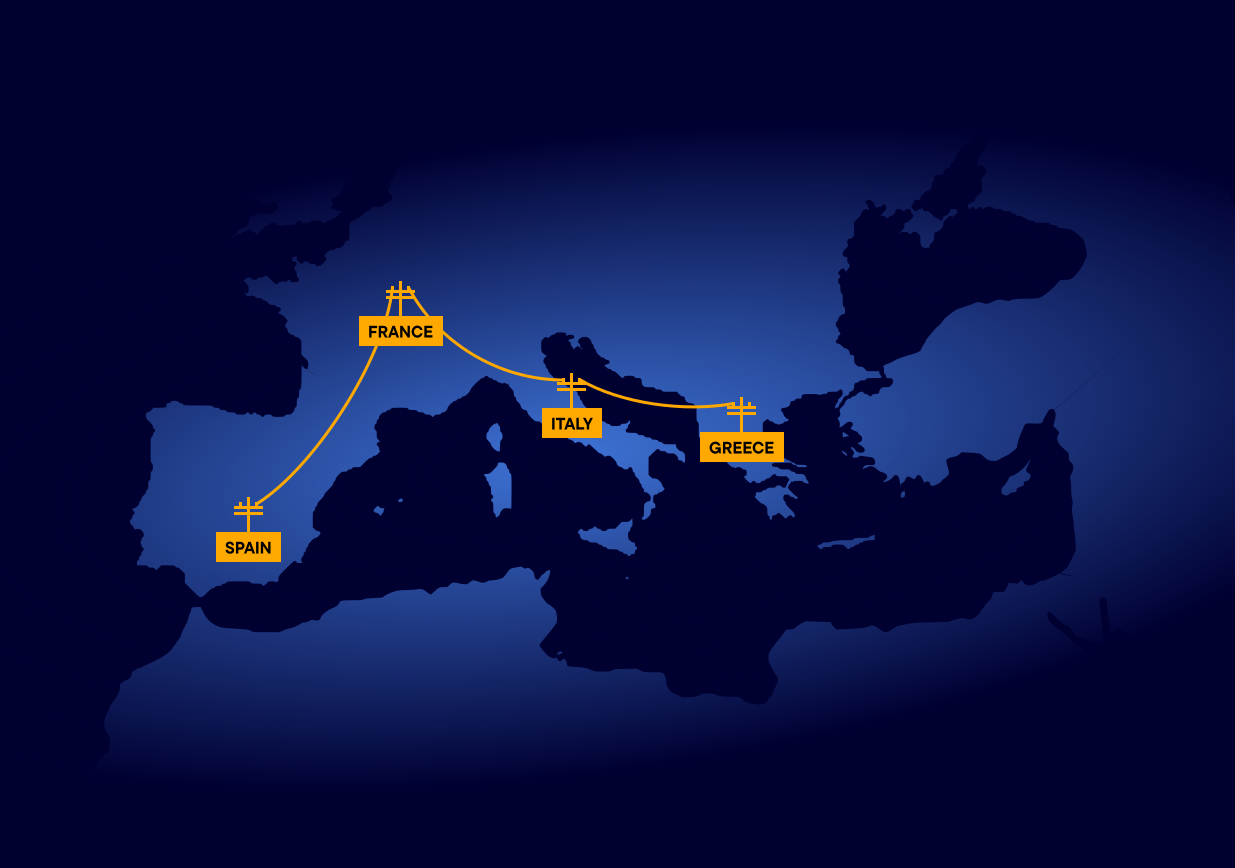
Four demonstrators across Europe have been selected to test the interoperability of the InterSCADA platform on different grids and to provide an evaluation of its key features.
Discover the pilots
The pilot site in Terni features a 700 VDC section integrated into the existing low voltage AC grid. It includes a photovoltaic array, a battery energy storage system with second-life batteries, and fast EV charging stations. The system supplies two office buildings, a warehouse, and critical loads, enhancing energy efficiency and grid reliability. Key components like AC/DC converters, DC/DC converters, renewable energy sources and distributed monitor and control infrastructures are leveraged to demonstrate the practical benefits of hybrid AC/DC grids in improving grid performance and resilience.
The Greek demonstrator will enhance grid operation and security by leveraging actual data from existing PMUs within an integrated AC/DC hybrid grid, including the Italy-Greece HVDC link. To this end, a wide area monitoring protection and control (WAMPAC) system will be deployed, with advanced algorithms designed to highlight its benefits in optimising grid operation and supporting security analyses. Ultimately, it will facilitate proactive decision-making and the early identification of potential issues, thus contributing to enhanced observability and situational awareness for system operators.
The Spanish control centre demonstration aims to test and evaluate capabilities of the InterSCADA platform applied to the operation of the Spanish transmission system. The EMS (energy management system) module of the InterSCADA platform, a key component in the control centre, and the AI agent for control centre support will be implemented and tested in the operation of hybrid AC-DC systems.
This demonstration targets the use of the InterSCADA system and top-of-the art algorithms to enhance transient stability management on the complete French system. It will enable a new and flexible approach to be tested and validated in an operational context for transient stability assessment. Such a method will offer RTE and any interested system operator the possibility to consider a larger number of scenarios while improving DC-based components modelling, thus deeply increasing the situational awareness in modern systems.